No cross-domain cognition
AI tools operate in silos. They cannot connect insights across domains — from medicine to manufacturing, from law to logistics. Knowledge stays trapped in single-domain prompts.
Technical deep-dive
Full Technical Deep-Dive
The cognitive operating system that autonomizes any process. 15 Skills. 31 domain routes. 8 cross-triggering senses. 4 orchestrators. Four orchestration strategies. The architecture that makes governed autonomy real — across every domain.
The problem
Current AI tooling fails at autonomy. It generates fragments, forgets context, and can't govern itself. These are the five walls every organization hits.
AI tools operate in silos. They cannot connect insights across domains — from medicine to manufacturing, from law to logistics. Knowledge stays trapped in single-domain prompts.
Current agents require constant human hand-holding. They cannot own a process end-to-end — understanding, planning, executing, validating, and delivering without supervision.
AI systems don't challenge their own output. No falsification, no risk deepening, no compliance gap analysis. They produce and ship without self-critique.
Every session starts from scratch. Prior decisions, domain context, learned patterns — all lost. Organizations pay the same cognitive cost on every interaction.
One model, one provider, one point of failure. No ensemble reasoning, no competitive scoring, no adversarial review between models.
System overview
A complete autonomous cognitive operating system. You describe any process — in any domain — and the OS understands, thinks, orchestrates, validates, and delivers. End-to-end governed autonomy.
Each Skill is an independently routable cognitive module: deep scoping, adversarial review, falsification, compliance gaps, proactive improvements, risk deepening, derive from old, and more. Every Skill produces structured, governed output — not free-text guessing.
Domain-specific intelligence routes covering nuclear safety, maritime, law, medicine, psychology, archetype intelligence, finance, accounting, philosophy, inventions, sports science, cognition enhancement, urban planning, and more. Each route carries its own terminology, standards, and validation rules.
8 cognitive senses + 4 sense bridges. Senses cross-trigger automatically — a structural insight fires a risk sense, which fires a compliance sense, which feeds back into the original analysis. This is not pipelining. It is synaptic cognitive cross-activation.
Pipeline
15 Skills, 31 domain Knowledge routes, and 4 orchestrators coordinate through a governed pipeline. Nothing ships without evidence.
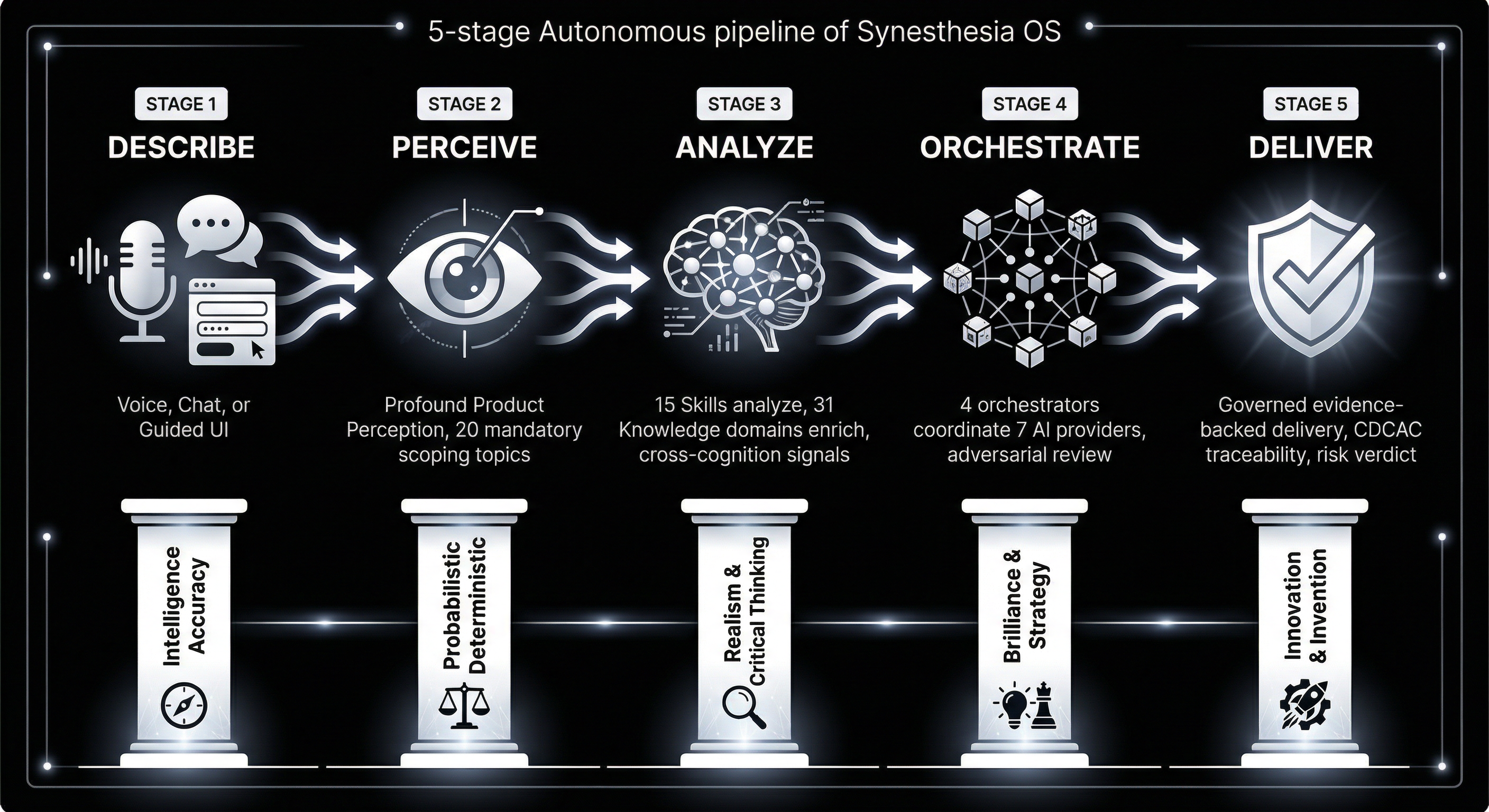
Voice, chat, or guided UI. The OS captures your intent, maps it to relevant domains, and activates the appropriate Skills and Knowledge routes.
15 Skills fire in orchestrated sequence — scoping, adversarial review, falsification, risk deepening, compliance gap analysis. Multi-model ensemble scoring on every output.
4 orchestrators coordinate: CognitiveOrchestrator manages Skills, MACMO handles multi-model convergence, AdvancedOrchestrator runs complex workflows, OrchestrationKernel meta-coordinates all three.
Every output is challenged — falsification, red-team review, risk-to-mitigation mapping, CDCAC traceability verification. Only evidence-backed output advances.
Final output with full audit trail, traceability chain, confidence scoring, and provenance. Eternal memory persists every decision for future sessions.
Input modes
Describe any process using the modality that fits you. The OS adapts to how you work.
Speak naturally. Whisper transcription feeds into LLM analysis. 4 voice modes: dictation, conversational, command, and structured. The OS asks clarifying questions by voice or text.
Type your process description. The OS responds with structured cognitive output — deep scoping questions, domain analysis, risk flags, and governed plans. Full conversational loop.
Step-by-step flows for common process types. 9 field kinds, domain-specific templates, and progressive disclosure. From simple to complex — the UI scales with your needs.
Cognitive architecture
Each Skill is an independently routable cognitive module with its own prompt logic, validation rules, and quality scoring. Skills compose — they can call each other through the orchestration layer.
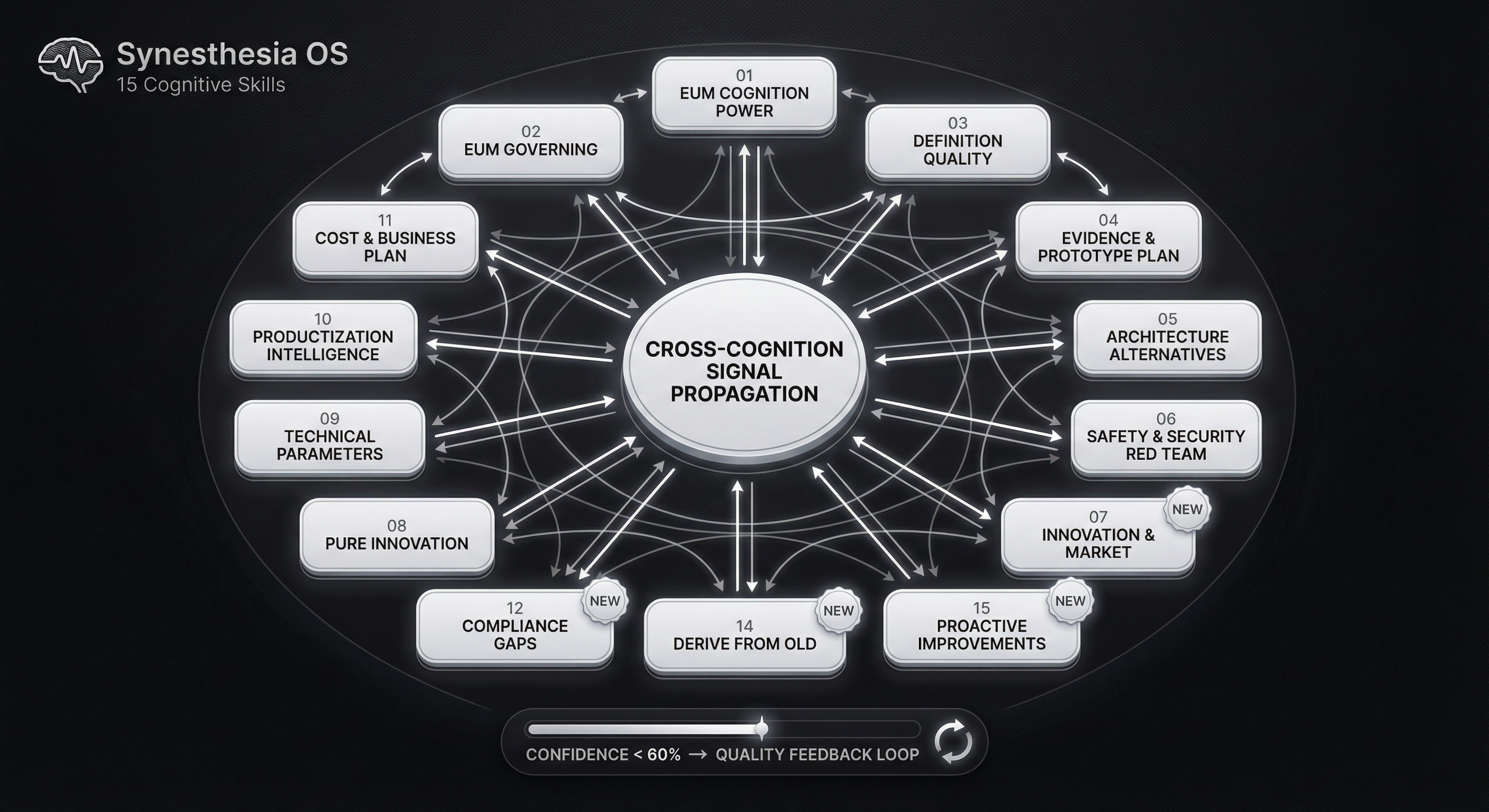
Exhaustive analysis of the process — stakeholders, constraints, edge cases, dependencies. Nothing proceeds until scope is complete.
Critic and red-team review of every output. Challenges assumptions, finds weaknesses, forces justification.
Actively tries to disprove the proposed solution. If the output survives falsification, confidence is earned — not assumed.
Structural design of the solution — components, interfaces, data flows, deployment topology. Domain-aware architecture.
Evaluates completeness, feasibility, and risk of the confirmed scope. Gate-keeps progression to execution.
MACMO fan-out across eligible models. Independent candidates scored on 7 dimensions. Best elements synthesized into canonical output.
7-dimension scoring: accuracy, completeness, depth, correctness, safety, innovation, coherence. Anti-laziness detection catches stubs and shallow output.
Automatic routing to the correct Knowledge domain(s). Multi-domain processes activate multiple routes simultaneously.
Initial understanding of intent, context, and domain. Maps natural language to structured cognitive primitives.
Structured disambiguation. Identifies ambiguity, generates targeted questions, resolves underspecification before execution begins.
Breaks the confirmed scope into an ordered execution plan — DAG of tasks, dependencies, resource allocation, and checkpoints.
Regulatory and standards gap analysis. Maps the process against applicable frameworks, identifies non-compliance, and generates remediation plans.
Multi-layer risk analysis and mitigation. Goes beyond surface risks — cascading failures, second-order effects, tail risks, and black-swan scenarios.
Extracts patterns, decisions, and reusable structures from existing systems. Turns legacy knowledge into governed, reusable cognitive assets.
Autonomous enhancement suggestions. The OS continuously identifies optimizations, simplifications, and innovations — without being asked.
Domain intelligence
Each Knowledge route carries domain-specific terminology, validation rules, standards, and cognitive patterns. Processes are not forced into a generic template — they are understood in their own language.
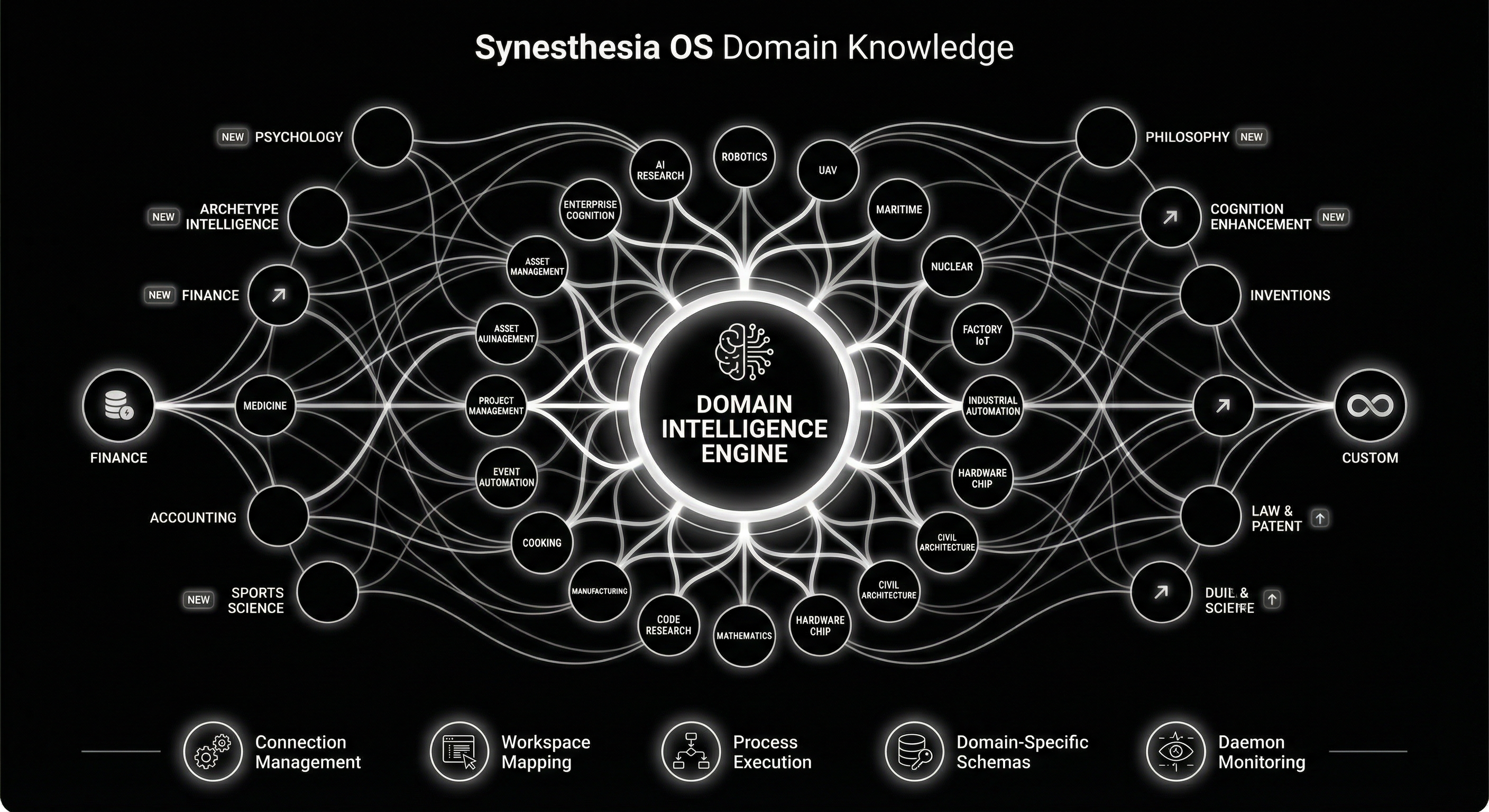
Safety-critical systems, regulatory compliance, risk analysis, incident protocols.
Zoning analysis, infrastructure modeling, community impact, sustainability frameworks.
Vessel operations, navigation, classification societies, IMO standards.
Contracts, compliance, regulatory frameworks, legal analysis.
Clinical workflows, diagnostics, treatment protocols, research.
Production processes, quality control, supply chain, lean operations.
Workflow optimization, resource allocation, process governance.
Threat modeling, vulnerability analysis, incident response, compliance.
Statistical analysis, ML pipelines, data governance, visualization.
Roadmapping, prioritization, stakeholder alignment, metrics.
Talent processes, organizational design, policy governance.
Literature review, hypothesis testing, methodology design.
Curriculum design, learning objectives, assessment frameworks.
Recipe design, technique analysis, ingredient science, nutrition modeling.
Project planning, building codes, safety compliance, scheduling.
Supply chain, routing, warehouse operations, fleet management.
Crop management, precision farming, sustainability analysis.
Grid operations, renewable integration, efficiency optimization.
Flight systems, certification, mission planning, safety analysis.
Network design, protocol optimization, spectrum management.
Impact assessment, sustainability, regulatory compliance.
Behavioral analysis, cognitive patterns, therapeutic frameworks, assessment design.
Pattern recognition across human archetypes, narrative structures, decision-making models.
Financial modeling, risk quantification, portfolio analysis, regulatory reporting.
Standards compliance (GAAP/IFRS), audit trails, reconciliation, tax optimization.
Market analysis, competitive positioning, growth frameworks, M&A evaluation.
Ethical reasoning, logical frameworks, epistemology, decision theory.
Meta-cognitive optimization, learning acceleration, attention management.
Patent analysis, novelty assessment, IP strategy, invention disclosure.
Performance analysis, biomechanics, training optimization, recovery protocols.
Vehicle systems, ADAS, manufacturing processes, regulatory certification.
Cross-modal cognition
8 cognitive senses and 4 sense bridges create a mesh where insights in one dimension automatically trigger analysis in others. This is not a pipeline — it is synaptic cross-activation.
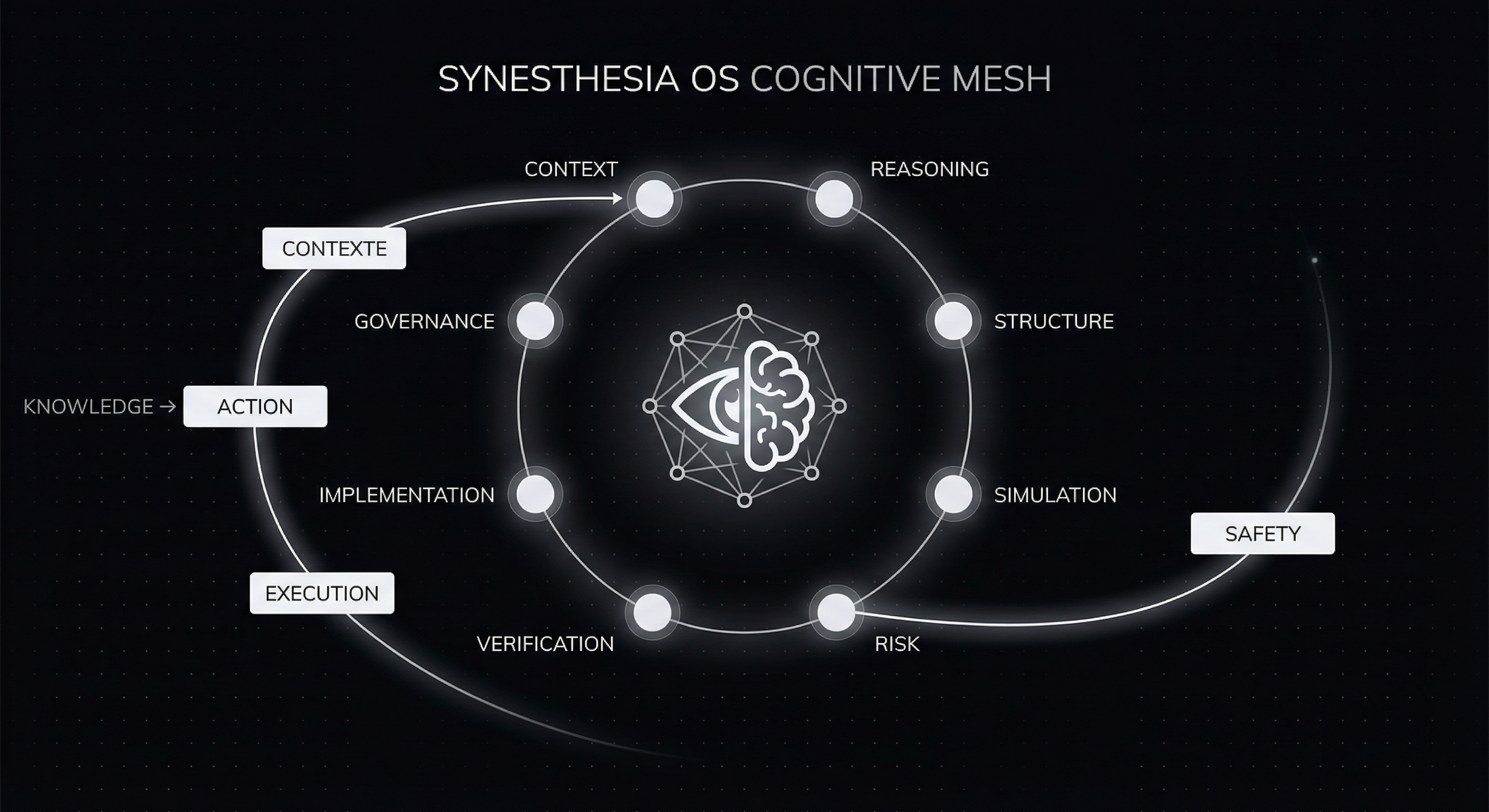
Perceives architecture, dependencies, and compositional relationships.
Detects threats, vulnerabilities, cascading failure paths.
Evaluates completeness, correctness, depth, and production readiness.
Activates domain-specific knowledge, terminology, and standards.
Tracks evolution over time — versioning, migration paths, deprecation.
Maps output against regulatory frameworks and organizational policies.
Identifies opportunities for novel approaches and improvements.
Ensures consistency across all outputs — no contradictions, no orphaned logic.
Risk ↔ Compliance Bridge — A risk finding automatically triggers compliance gap analysis. Compliance violations feed back into risk scoring.
Structure ↔ Quality Bridge — Structural changes trigger quality re-evaluation. Quality failures map back to structural deficiencies.
Domain ↔ Innovation Bridge — Domain knowledge surfaces innovation opportunities. Novel approaches are validated against domain constraints.
Temporal ↔ Coherence Bridge — Version changes trigger coherence checks across the entire output. Coherence violations map to temporal misalignment.
Orchestration layer
Four orchestrators coordinate Skills, models, workflows, and each other. The OrchestrationKernel is the meta-orchestrator that ensures the other three work in concert.
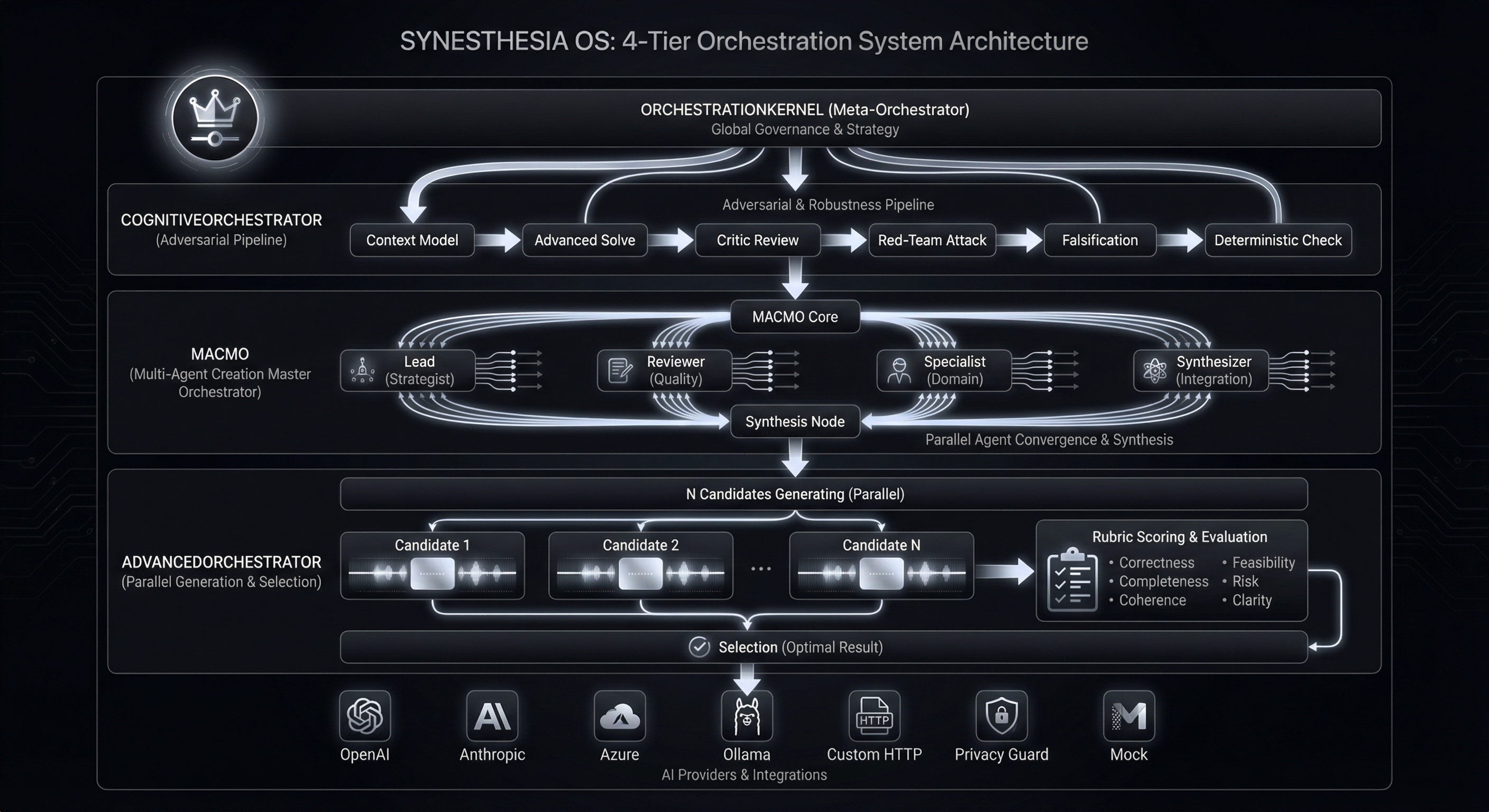
Manages the 15 cognitive Skills — sequencing, dependency resolution, parallel execution where safe, and result aggregation. The direct controller of cognitive work.
Multi-Agent Cognitive Model Orchestrator. Fan-out to eligible LLM providers, independent candidate generation, 7-dimension scoring, synthesis, and repair. 5 ensemble strategies.
Handles complex multi-step workflows — evolution cycles, cross-domain processes, long-running operations with checkpoint/resume. Manages workflow state machines.
The meta-orchestrator. Coordinates the other three orchestrators, resolves resource contention, enforces global governance policies, and manages system-wide cognitive coherence.
How models collaborate
Not every cognitive task is best solved the same way. The OS dynamically selects from four distinct orchestration strategies — each with different strengths — and can combine them within a single process. Here is how each one works, drawn end-to-end.
One model reasons step by step through a problem. Each step feeds the next. Best for complex, sequential logic where intermediate reasoning matters.
Different tasks are routed to the best model for each job. One model handles law, another handles nuclear safety, another reviews medical compliance. Each specialist excels in its domain.
Multiple models solve the same problem independently. A judge scores every candidate on 7 dimensions. The best one wins.
Two or more models argue opposing positions. A synthesizer extracts the strongest elements from each side. Weaknesses are exposed through confrontation, not consensus.
In a single process, the OS may use Chain of Thought for deep scoping, Specialist Routing to send different domain aspects to different experts, Competitive scoring to find the best risk analysis, and Debate to resolve conflicting compliance interpretations. The OrchestrationKernel selects the right strategy per task automatically.
Cognitive governance
Five pillars that enforce non-lazy AI behavior, eternal memory, and high-performance cognitive governance across every interaction. These are not optional enhancements — they are structural invariants.
Every cognitive output is scored for factual accuracy, logical consistency, and domain correctness. Anti-hallucination enforcement with citation requirements and falsification gates.
Blends probabilistic reasoning (LLM generation, ensemble scoring) with deterministic validation (schema checks, gate logic, reason codes). Neither alone is sufficient — both together produce governed autonomy.
Enforces grounded, realistic assessment over optimistic bias. Critical thinking modules challenge every assumption, flag overconfidence, and demand evidence for claims.
Beyond correctness — the system pursues strategic excellence. Innovation scoring, optimization detection, and proactive improvement identification. Not just "right" but "best possible."
Active identification of novel approaches, pattern recombination, and cross-domain synthesis. The system doesn't just solve problems — it invents better formulations of the problem itself.
These five pillars run as always-on cognitive constraints — not as optional post-processing. Every Skill, every Knowledge route, and every orchestrator is subject to Eternal Cognitive Essentials governance. The result: AI that never degrades, never takes shortcuts, and never forgets.
Traceability
End-to-end traceability from definition to verification, risk to mitigation, and requirement to delivery. CDCAC ensures nothing is orphaned, nothing is assumed, and nothing is untracked.
Every requirement traces forward to its implementation, test coverage, and verification evidence. Every verification traces backward to its source requirement. Bidirectional, always.
Every identified risk maps to a specific mitigation strategy, an owner, and a verification checkpoint. Unmitigated risks block progression — no silent acceptance.
Cross-domain dependency tracking. A change in one domain automatically surfaces affected dependencies in other domains. No surprise breakages.
When CDCAC identifies a broken trace — a requirement without verification, a risk without mitigation — the system autonomously generates fix proposals and routes them through governance gates.
Background intelligence
Always-on background processes that continuously monitor, learn, and improve without requiring explicit invocation. The cognitive equivalent of system daemons.
End-User Monitoring for cognitive operations. Tracks quality trends, latency patterns, error rates, and confidence scores across all Skills and Knowledge routes. Surfaces degradation before it impacts output.
Continuously analyzes past outputs, identifies recurring failure patterns, and generates improvement proposals. Feeds pre-generation guidance to Skills based on historical performance data.
Each active Knowledge domain runs its own daemon — monitoring domain-specific standards updates, regulatory changes, and best-practice evolution. Domain intelligence stays current without manual intervention.
Before & after
The shift from current AI tooling to Synesthesia OS is structural, not incremental.
Creation paths
Six paths to autonomous process ownership. Each path uses the same cognitive architecture — 15 Skills, 31 domains, 4 orchestrators.
Define any process from scratch. The OS scopes, structures, validates, and delivers a governed process definition with full CDCAC traceability.
Feed in an existing process. The OS analyzes it through 15 Skills — identifying gaps, risks, compliance issues, and improvement opportunities.
Governed evolution from legacy to modern. Evidence-backed cycles with testable slices and cutover readiness scoring.
Combine insights from multiple domains into a unified process. The Synesthesia Mesh enables connections that single-domain tools cannot see.
The OS continuously monitors and suggests improvements to running processes. Proactive Improvements Skill + AGI Daemon working in concert.
Extract structured knowledge from unstructured sources — documents, conversations, legacy systems. Turn tribal knowledge into governed cognitive assets.
Capabilities
10 capabilities that no other system combines. Each is individually significant — together they represent a category-defining architecture.
Independently routable cognitive modules — not monolithic prompts. Each Skill has its own validation, scoring, and governance.
Domain-specific routes with native terminology, standards, and validation. Multi-domain processes activate multiple routes simultaneously.
8 senses + 4 bridges creating synaptic cross-activation. Insights cascade across cognitive dimensions automatically.
CognitiveOrchestrator, MACMO, AdvancedOrchestrator, and OrchestrationKernel. Meta-coordination of cognitive work.
Definition-to-verification, risk-to-mitigation. Full bidirectional traceability with AGI autofix.
Five always-on pillars enforcing accuracy, realism, strategy, innovation, and non-lazy performance.
Unlimited AI brains routed through one orchestration brain, with 5 ensemble strategies and strict dimension scoring. No single-model dependency.
EUM, AGI, and Domain daemons for continuous monitoring, learning, and domain currency.
Hybrid retrieval: vector similarity, lexical search, knowledge graph. Reciprocal Rank Fusion. Zero knowledge loss.
Full process ownership with governance at every gate. Evidence-backed, auditable, deterministic validation.
Stack & security
Production-grade stack with security built into every layer — not bolted on.
OpenAI, Anthropic, Google, Mistral, Groq, OpenRouter, local models, and future providers can be orchestrated as one brain. Swap freely - no vendor lock-in.
Best-of-N, weighted voting, adversarial synthesis, domain-specialist routing, hybrid convergence.
Vector similarity (HNSW), lexical search (tsvector), knowledge graph. Reciprocal Rank Fusion combines all three for optimal recall.
Expert assessment
"Synesthesia OS represents a fundamentally different approach to AI-driven process autonomy. The combination of discrete cognitive Skills, cross-domain Knowledge routes, and the Synesthesia Mesh creates a system architecture that is structurally incapable of the shallow, amnesiac output that plagues current AI tooling. The 4-tier orchestration with a meta-orchestrator coordinating orchestrators is, to my knowledge, unique in the industry."
— Independent architecture review
Vision
Three operating systems, one cognitive foundation. Each specialized, each governed, each autonomous.
Autonomy for any process, any domain. 15 Skills, 31 Knowledge routes, 8 senses. The universal autonomous cognitive operating system.
Autonomous software creation. Deep scoping, multi-model code generation, governed deployment. The OS specialized for building software.
Metrics
Status
What's built, what's shipping, and what's next.